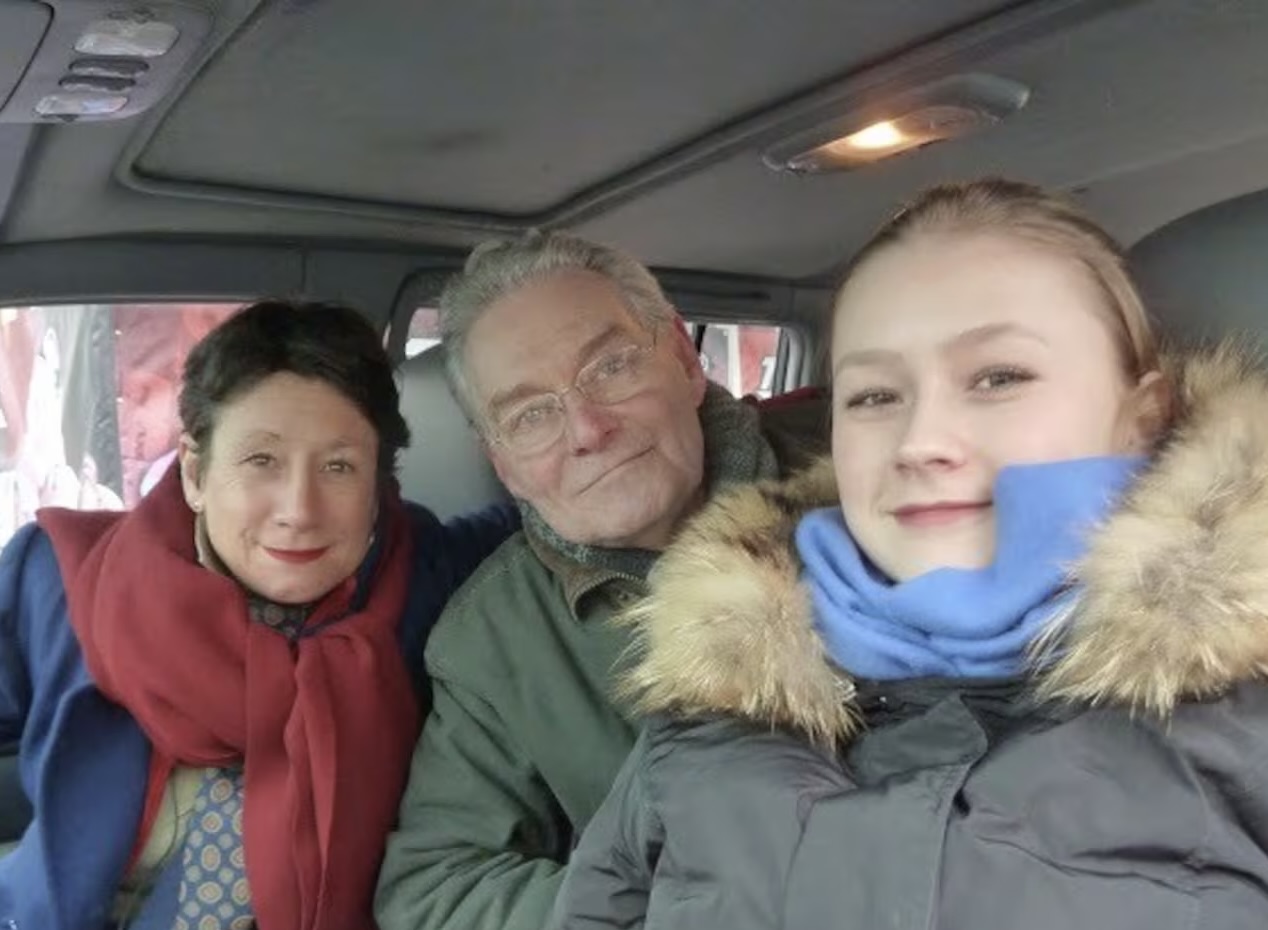
The granddaughter of a prominent Nazi has said she will be “forever grateful” for the opportunity to meet and discuss the past with Irish Holocaust survivor Tomi Reichental.
PAKH-board and co-speaker Alexandra Senfft on Newstalk, Claire Byrne Show, Ireland, paying tribute to Holocaust survivor Tomi Reichental
>> go to Claire Byrne Show, June 4th, 2026
My Nazi grandfather sent Tomi Reichental to Bergen-Belsen death camp
Despite all the suffering he endured, the Holocaust survivor chose compassion over hate
PAKH-board member and co-speaker Alexandra Senfft pays tribute to Holocaust survivor Tomi Reichental
Irish Times, June 1, 2026
I was deeply anxious during the train journey from Vienna to Bratislava, the Slovak capital, in 2014. Holocaust survivor Tomi Reichental was expecting me there, together with Gerry Gregg’s film crew. They were shooting the documentary Close to Evil.
Tomi was born in Czechoslovakia but moved to Ireland in 1959. He had been a young boy when he and his family were deported by the Nazis to the Bergen-Belsen concentration camp in Germany in 1944. Tomi survived, but 35 of his relatives were murdered in the Holocaust; his grandmother died before his eyes in the camp.
My grandfather, however, was Hanns E Ludin, the “envoy of the Third Reich to Slovakia”, and it was he who signed the deportation orders. Ludin was convicted as a war criminal and executed in Bratislava in 1947…
>> go to contribution

Tribute to Tomi Reichental
PAKH-member Oliver Sears, Founder of Holocaust Awareness Ireland, pays tribute to Tomi Reichental, Holocaust survivor, who passed away aged 90.
01 JUN • 8 MINS • MORNING IRELAND
RTE Radio Ireland
>> listen to interview on RTE
It Takes More Courage to Love Than to Hate
On the Day of Remembrance for the Victims of National Socialism
27th January 2026
“It takes more courage to love than to hate.” This sentence, taken from the Berlin exhibition “Believing in a Future. Jewish Biographies in the Parliamentary Founding Generation after 1945. A Documentary Approach”, was spoken by Jeannette Wolff, a Jewish Holocaust survivor and one of the first members of the German Bundestag.
The Executive Board of our Study Group on Intergenerational Consequences of the Holocaust (formerly PAKH – Psychotherapeutic Working Group for Those Affected by the Holocaust) was invited to the exhibition opening at the German Bundestag on 27 January 2026, the “Day of Remembrance for the Victims of National Socialism”. The board was represented by Peter Pogany-Wnendt.
Jeannette Wolff’s words are as moving as they are timely. Social and political discourse in Germany, as well as political action worldwide, reveal a growing lack of dialogue, empathy, and respect for human dignity. Antisemitism, anti-Romani racism, hostility toward Muslims, and other forms of group-based hatred are increasingly expressed openly and without shame. Where, in all of this, is the courage to love?
Precisely the remembrance of the victims of Nazi terror should remind us not only to invoke humanity and human rights, but to live by them. “Without love, humanity could not survive a single day,” warned the psychoanalyst Erich Fromm decades ago.
Re/Connecting emotions and impacts on teachingAn autoethnography of a missing national socialist family narrative
by PAKH-member Anne Wihstutz, in: Ethnography and Education, October, 7th, 2025
ABSTRACT
This paper elaborates on the particular relationship between emotion, memory and teaching in Higher Education in post-Nazi Germany. Emotions as social patterns connect the individual with the social. They play a crucial role in collective and individual memories. The author discloses in her autoethnography how she is reconnecting emotionally to a missing National Socialist family narrative, discussing the impacts of this reflective writing process on her teaching and memory work in early childhood teacher education. The autoethnographic approach provides insights into workings of emotional experiences which are otherwise difficult to grasp, like speechlessness. Challenges and opportunities of autoethnography are discussed regarding education’s aim to enable a transformation of self and world relations. The paper argues for the adoption of a global and comprehensive approach in memory work and education against moralising and formulaic, identity-related practices.
>> go to article
PAKH in: Breaking the Silence
Looking back at World War II Family Histories
Surveys in recent history have shown that many Germans want to believe that their ancestors had nothing to do with the crimes committed by Nazi Germany. Members of the younger generation, though, now want to know for sure — also out of concern for Germany’s political future
By Susanne Beyer, Der Spiegel Geschichte 19/2025, May 3rd 2025
„Children, meanwhile, have an extremely intimate relationship with their parents, says the Cologne-based doctor and psychotherapist Peter Pogany-Wnendt, the descendant of Holocaust victims who is a member of the board at the Working Group for Intergenerational Consequences of the Holocaust. First and foremost, he says, because children are existentially reliant on their parents during the first years of their lives. „The close bonds remain even if they don’t get along well” – which means, he says, that the stories told by parents are often not questioned.“
>> read full article (behind paywall), der Spiegel 19/25
The Holocaust and inherited memory
How we remember in the 21st century
By PAKH-member Oliver Sears (Holocaust Awareness Ireland)
Oliver Sears explores Holocaust memorialisation through the prism of his own remarkable and tragic family history. How best, he asks, do we honour and preserve history, in the 21st century?
Yom HaShoah, which fell on 23 April this year, was the first official Holocaust Memorial day, established in Israel in 1951 to commemorate the Warsaw Ghetto Uprising in 1943. It took another 54 years before the UN designated 27 January International Holocaust Memorial Day.
With extraordinary courage and, knowing that they could not possibly win, a group of young, poorly armed ghetto fighters defied the might of the SS for a month, stemming the continuous deportation of Jews from the ghetto to Treblinka, a death camp north of Warsaw where some 900,000 Jews were murdered in 18 months, gassed within 90 minutes of arrival. 90 per cent of the Warsaw ghetto was deported to Treblinka, where there were no more than 60 survivors. While their resistance was futile, the ghetto fighters bought the 55,000 remaining ghetto residents an extra month of life, a month which offered them their last winking ember of hope before the ghetto was finally liquidated and they, too, were deported to their deaths.

A Café Called Dorice
PAKH-member Oliver Sears on RTE Radio 1
On a family friend, Josef Cukier, stranded in London at the outbreak of WW2, and his plan to rescue his wife and two daughters, Jews caught in the chaos and terror of Nazi-occupied Poland
>> listen to RTE

PAKH-Memer Oliver Sears in the Irish Times
I think of the hostages and their tortured families and weep for the broken generations in Gaza. Whatever injustice, historic and current, that successive Israeli governments have served to the Palestinians, there is no resonance with the Holocaust
The Irish Times, 6th May 2024
I was invited to join PAKH, the study group for intergenerational consequences of the Holocaust, last September. Comprising the descendants of victims and perpetrators, we meet to discuss our impossibly complex family stories.
Recently, online, we listened to Israeli Rami Elhanan and Palestinian Bassam Aramin explain how they work together to promote peace. The subjects of Colum McCann’s 2020 novel, Apeirogon, these heroic men each lost a daughter in the decades-long conflict. Their determination to focus on the importance of respecting the rights of the individual, their lack of self pity and how they have come to rely on each other, emotionally, is humbling to observe.
Both men possess the insight of inherited trauma, along with their own piercing personal loss. Bassam’s stems from the displacement of his people, Rami’s mother was, as he says laconically, a graduate of Auschwitz. They both agree that the absence of Palestinian self-determination was the reason they lost their children and that Israeli society entire needs a total reset. It’s clear to them that both Hamas in Gaza and the settlers who have taken over the Israeli cabinet are a disaster for both peoples…
These two remarkably dignified, emotionally literate men are the embodiment of Viktor Frankl’s maxim that to understand your own pain you must first help someone else understand theirs; and that when pain has meaning, it is no longer pain. Bassam says they are not friends but are brothers. They show us what is required to break the cycle of hatred. Rami was clear that it’s not necessary for Palestinians and Israelis to love each other but respect is the key.
As I think of the hostages and their tortured families and weep for the broken generations in Gaza, I accept with an open heart that, among my fellow PAKH members, I have come to love and embrace children and grandchildren of monsters. And this, in the Ashkenazi tradition of trying to repair the world, headache by headache. On Yom HaShoah, I sense this is the furthest point from despair that a heart like mine can travel within the boundaries of this difficult inheritance.
Oliver Sears is founder of Holocaust Awareness Ireland
Event
Breaking the Spell of the Nazi Past: How to find a voice and a language to address NS war crimes within one’s own family
with PAKH second chair Alexandra Senfft
Center for German and European Studies, Brandeis University
Wednesday, December 13, 2023
>> listen to event